Sous Vide Time & Temperature Calculator
Pick your protein, cut, thickness, and doneness — get the exact temp and time to set your circulator to.
Sous vide works because cooking is just a temperature problem. A steak that's 130°F at the center is medium-rare; one that's 145°F is medium. Traditional cooking is a fight to hit the right final temp without overshooting — sous vide eliminates the fight by holding the water bath at the exact target. Once the meat equilibrates, it stays there, with a window of hours where quality stays identical.
The trick is knowing two numbers: the temperature for the doneness you want, and the minimum time for safety and heat penetration at that thickness. Time scales with the square of thickness, not linearly — a 2" steak needs roughly 4× the time of a 1" steak. And every protein has a different minimum: chicken pasteurizes faster than beef at the same temp because of bacterial profile differences.
This calculator combines published pasteurization tables (USDA + Baldwin reference) with thickness-scaling formulas to give you a precise time-and-temp pair for any cut and doneness. We then match against sous vide circulators that fit your usage — wattage for your vessel size, accuracy spec for low-temp work, and quality of the pump for circulation consistency in larger water baths.
Protein
Cut
Thickness
1.5"Doneness
Set your circulator to
Temperature
129°F
53.9°C
Time
1 hr
For 1.5" thick steak (ribeye, ny strip, sirloin). Most cuts have a wide pasteurization window — going an extra hour rarely hurts.
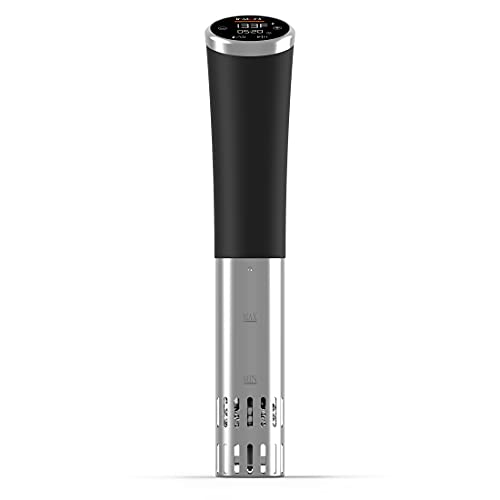
Top-rated sous vide circulators
Reliable temperature accuracy is the spec that matters most for these times to hit.



How this works
How is sous vide time calculated for thickness?
Heat penetrates the center of a cut roughly proportional to the square of thickness. A 2" steak takes ~4× the time of a 1" steak, not 2×. We scale the base time accordingly and cap at the maximum safe holding time. The math comes from Baldwin's sous vide reference, which is the gold-standard practical guide.
Can I leave food in longer than the recommended time?
For most cuts, yes — within the cut's max time. Beef, pork, and lamb tolerate going an extra hour without quality loss. Fish and eggs are time-sensitive (proteins overcoagulate). Vegetables get mushy if held too long. Tough cuts like short rib and chuck actually benefit from 24-72 hour holds at low temps for collagen breakdown.
Are these times safe at low temperatures?
Yes, when the time is long enough for pasteurization at that specific temperature. The default times here meet USDA pasteurization standards (5-log reduction of Salmonella). Lower temps require longer hold times — 130°F beef needs 2 hours minimum; 140°F just 25 minutes. The calculator builds in the right minimum automatically.
How do I get a good sear after sous vide?
Dry the surface thoroughly with paper towels, then sear in a screaming-hot cast iron with high-smoke-point oil (avocado, peanut, ghee) for 30-45 seconds per side. A torch works for hard-to-reach surfaces. The dry-sear step is non-negotiable — wet surfaces steam instead of brown.
What's the right sous vide circulator wattage?
For most home use, 1000W is the sweet spot. Below 800W struggles to maintain temp in larger vessels (above 8 quarts). Above 1100W mostly buys faster initial heat-up — useful if you cook frequently but not critical. Pay more attention to flow rate (gallons/minute) and pump quality.
Do I need a vacuum sealer?
No, but it helps. Ziploc bags with the water-displacement method work fine for steaks, chicken, vegetables, and short cooks. For long cooks (12+ hours), vacuum sealing prevents oxidation and floating. A $100 vacuum sealer pays for itself if you sous vide weekly.
Can I sous vide from frozen?
Yes — add 50% to the base cook time and let the calculator adjust for thickness as if the food were still frozen at the center. This works great for steaks and chicken breasts. It does NOT work for thick or irregularly shaped cuts (whole chickens, large roasts) where heat penetration is too uneven.
How long does sous-vide food keep after cooking?
In the sealed bag, vacuum-packed and immediately ice-bath chilled: 7-14 days refrigerated, 4-6 weeks frozen. Open the bag and it becomes regular leftovers (3-4 days max). Batch cooking sous vide is one of its best features — pasteurize on Sunday, sear during weeknight dinners.